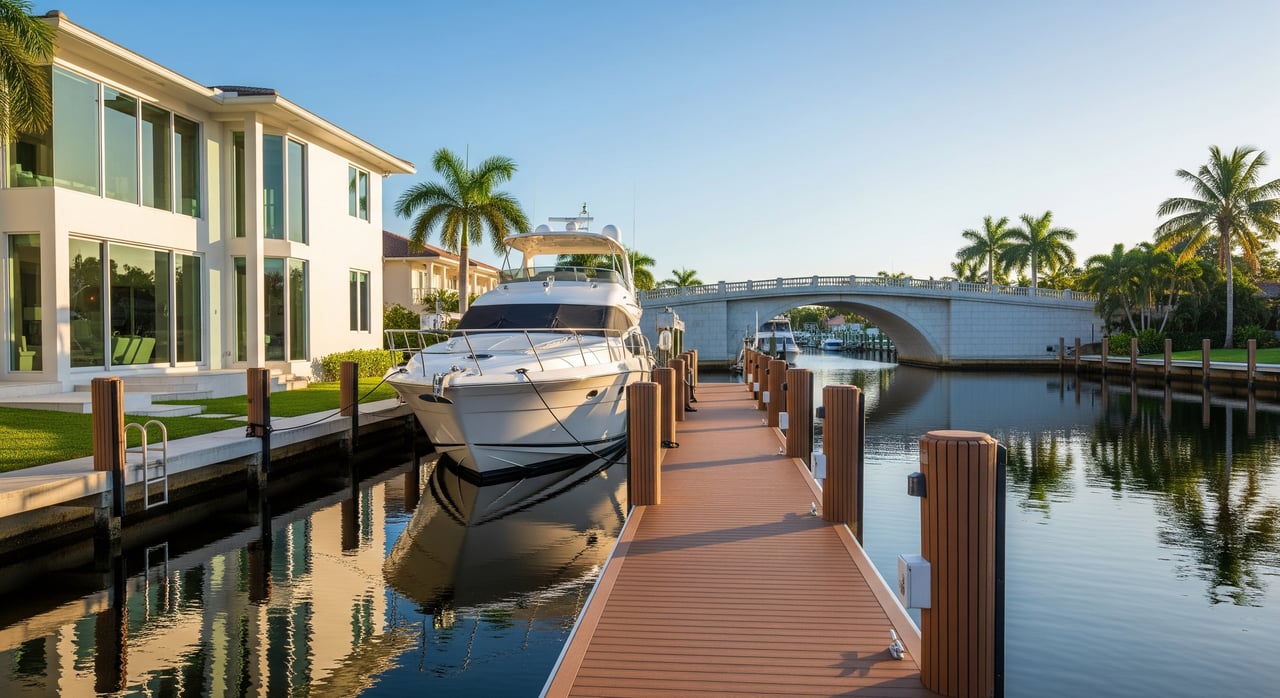
Will your boat clear the bridge between your new Fort Myers canal home and open water? If you are shopping for a waterfront property, that question can make or break your lifestyle plans. You deserve clear, practical guidance before you fall in love with a view that your vessel cannot reach. In this guide, you will learn how to verify bridge clearance and canal depth in Fort Myers, what to check before you write an offer, and how to avoid costly surprises. Let’s dive in.
Bridge clearance basics
Bridge clearance is about air draft, which is the height of your boat from the waterline to the tallest fixed point. Your air draft must be lower than the bridge’s vertical clearance at the time you pass. Fixed bridges publish a clearance relative to a chart datum, and movable bridges follow operating rules that determine when they open.
Depth matters too. Your boat’s draft needs enough water from the canal to the main channel. Depths on charts are shown relative to a datum like Mean Lower Low Water, and tides, shoaling, and load can change what is actually available.
Do not forget horizontal factors. A narrow canal, tight turns, bridge pier spacing, or overhead lines can limit safe passage even if the paper numbers look fine. Give yourself margin for wind, current, and steering room.
Tides still count here. Fort Myers tides are modest compared with ocean inlets, but a foot or two can decide a tight clearance. Always confirm which datum a chart uses and time your trial run with local tide predictions.
Fort Myers waterways at a glance
Most residential canals in Fort Myers tie into the Caloosahatchee River or the protected waters that lead to San Carlos Bay and the Gulf. Some canals are small and privately maintained by owners or associations, while larger channels and the river have defined project depths maintained by public agencies.
Bridge types and clearances vary around the area. High-level crossings and causeways exist near the river and barrier islands, but many community and neighborhood bridges have lower fixed clearances. Conditions can shift after storms. Heavy runoff, debris under bridges, and sedimentation can reduce both depth and width until the next maintenance cycle.
Ownership affects maintenance. Public channels may have scheduled dredging, while private canals often depend on HOA assessments or owner-funded projects. Knowing who maintains a canal tells you who will handle shoaling, debris, and any future dredging needs.
Step-by-step verification for your boat
The goal is simple: match your vessel’s real dimensions with the real-world bridge and channel conditions on your route to open water.
Gather vessel specs
- Record your exact air draft at normal load. Include mast height, radar arches, antennas, outriggers, and dinghy on davits.
- Note your loaded draft and how passengers, fuel, and water change it.
- Confirm whether gear can fold or lower to reduce air draft, and by how much.
Do desk research with charts and tides
- Review nautical charts for your canal and the path to the river or bay. Note published bridge clearances, overhead obstructions, and channel depths.
- Confirm which chart datum is used for both clearances and depths. This matters when you time your passage against tides.
- Pull local tide predictions for your planned test window so you can create best-case and worst-case scenarios.
- Check county resources for canal ownership and any recorded dredging or permits. Look for maintenance history and who pays for it.
Call local contacts
- Ask Lee County departments about canal ownership, public maintenance, and any planned bridge work.
- Call nearby marinas, harbormasters, or yacht clubs to learn what vessel sizes commonly use the route and where shoaling is reported.
- If a movable bridge is on your route, confirm the operating schedule and request procedures under federal drawbridge rules.
Inspect onsite
- Visit at low tide to see worst-case depth, and again near high tide if vertical clearance is tight. Take photos of posted clearance boards on bridges.
- Sound depths with a portable sonar or lead line at the center and edges of the canal and under any bridge. Note the shallowest spot and any debris.
- Estimate bridge clearance to the underside of the structure and compare it with your air draft plus a safety margin. Look for overhead lines.
- Evaluate turning room, current, and wake exposure. A boat that fits on paper still needs space to maneuver safely.
When to hire professionals
- If your margins are within 1 to 2 feet for depth or vertical clearance, bring in a marine surveyor or licensed captain. They can run soundings, check prop and shaft clearance, and document findings.
- For dredging, easements, or permitting questions, consult a marine engineer or an attorney experienced in Florida environmental permitting and waterfront property.
- For high-value vessels, consider a hydrographic surveyor to tie measurements precisely to chart datums.
What to document
- Canal maintenance and dredging records with dates and target depths.
- Bridge clearance listings or official chart excerpts that show the datum.
- Tide station predictions for your planned test.
- HOA or deed restrictions for lifts, mooring, and canal use.
What different boats need
You should always rely on your actual specs, but these general ranges help you gauge fit while you research.
- Small skiffs and flats boats often draw under 1 foot and have low air draft. They are well-suited to shallow, narrow canals.
- Center-console and bay boats commonly draw 1 to 2.5 feet. Air draft is usually modest, though T-tops and towers add height.
- Dual-console and cuddy boats typically draw 1.5 to 3.5 feet depending on size and load.
- Express cruisers, small trawlers, and mid-size motor yachts often draw 3 to 5 plus feet. Air draft may be 8 to 20 feet or more with arches and antennas.
- Sailboats commonly draw 4 to 7 plus feet, and mast heights vary widely. Many cannot pass under low fixed bridges without lowering the mast.
For comparison, apply practical margins. For draft, add at least 6 to 12 inches in sheltered waters, and 1 to 2 feet or more for heavier boats or shallow, variable canals. For air draft, target at least 1 to 2 feet of extra clearance, and 2 to 3 plus feet for larger craft or when tide and wind are uncertain.
Mitigation if you are close
If your numbers are tight, there are ways to improve your margin without changing homes.
- Time your passage to catch helpful tides for depth or clearance.
- Lighten the boat by reducing fuel, water, and gear to decrease draft.
- Lower or remove antennas, fold a radar arch, or unstep a mast if your vessel design allows it.
- Choose an alternate route or keep the vessel at a nearby marina with deepwater access, using a smaller boat or dinghy at the home.
- For private canals, owners or associations can pursue permitted dredging. This requires county and state approvals and can be costly, so verify feasibility early.
Red flags to watch
Certain findings should prompt deeper diligence or a change of plan.
- The canal is private with no recent maintenance records or active funding for dredging.
- Your measured depths leave less than your recommended safety margin above the boat’s draft.
- A fixed bridge’s posted clearance is lower than your air draft plus margin, and you cannot reduce height.
- The channel is narrow with limited turning room for your boat’s length and beam.
- The area sees repeated shoaling or post-storm debris without a documented maintenance plan.
Quick due-diligence checklist
- Confirm your boat’s exact draft and air draft at typical load.
- Pull charts for the canal and route to the river or bay. Note bridge clearances, overhead obstructions, and channel depths with datums.
- Check local tides for planned test dates and create best-case and worst-case scenarios.
- Ask the seller or HOA for canal maintenance history, last dredge date, and funding details.
- Call Lee County and nearby marinas for current conditions and any scheduled bridge work.
- Inspect onsite at low tide with a sounder or lead line and photograph clearance boards.
- Keep copies of charts, tide predictions, and maintenance records with your offer package.
How this fits your purchase strategy
If boating is central to your move, verifying bridge clearance and water depth should happen before you write an offer. That way, your inspection period focuses on confirmation, not discovery. When you structure your contract, include the right contingencies to allow an on-water test and time to gather records from an HOA or county office.
If you are also planning upgrades, factor in seawall condition, dock configuration, and lift capacity alongside your access evaluation. Coordinating these early helps you design a waterfront setup that fits your vessel and your canal’s constraints.
Your next move
You do not need to navigate this alone. With decades of waterfront development experience, permitting knowledge, and hands-on construction insight, Jonathan helps you match the right Fort Myers canal home to your vessel and boating goals. If needed, he can coordinate local professionals, review maintenance records, and structure a smart due-diligence plan so you can buy with confidence.
Ready to secure the right waterfront fit? Connect with Jonathan Gunger for a focused search and technically informed guidance.
FAQs
What does bridge clearance mean for a Fort Myers canal home?
- Bridge clearance is the vertical space under a bridge; your boat’s air draft must be lower than that clearance at the time you pass, with a safety margin.
How do I measure my boat’s air draft for a Fort Myers route?
- Measure from the waterline to your highest fixed point, including arches and antennas, at typical load, then add a 1 to 2 foot safety margin.
Do Fort Myers tides really affect clearance and depth?
- Yes, local tides are modest but a 1 to 2 foot swing can decide marginal clearances and depths, so plan around tide predictions.
Who maintains canal depths in Fort Myers neighborhoods?
- Some canals are publicly maintained, but many are private or HOA-managed; maintenance responsibility varies by canal and should be verified.
What if a fixed bridge on my route is too low for my boat?
- You can sometimes reduce air draft by lowering antennas or arches, choose an alternate route, or keep the boat at a nearby marina instead.
When should I hire a marine surveyor during a canal-home purchase?
- If your depth or clearance margins are within 1 to 2 feet, bring in a marine surveyor or captain to run soundings and confirm safe access.