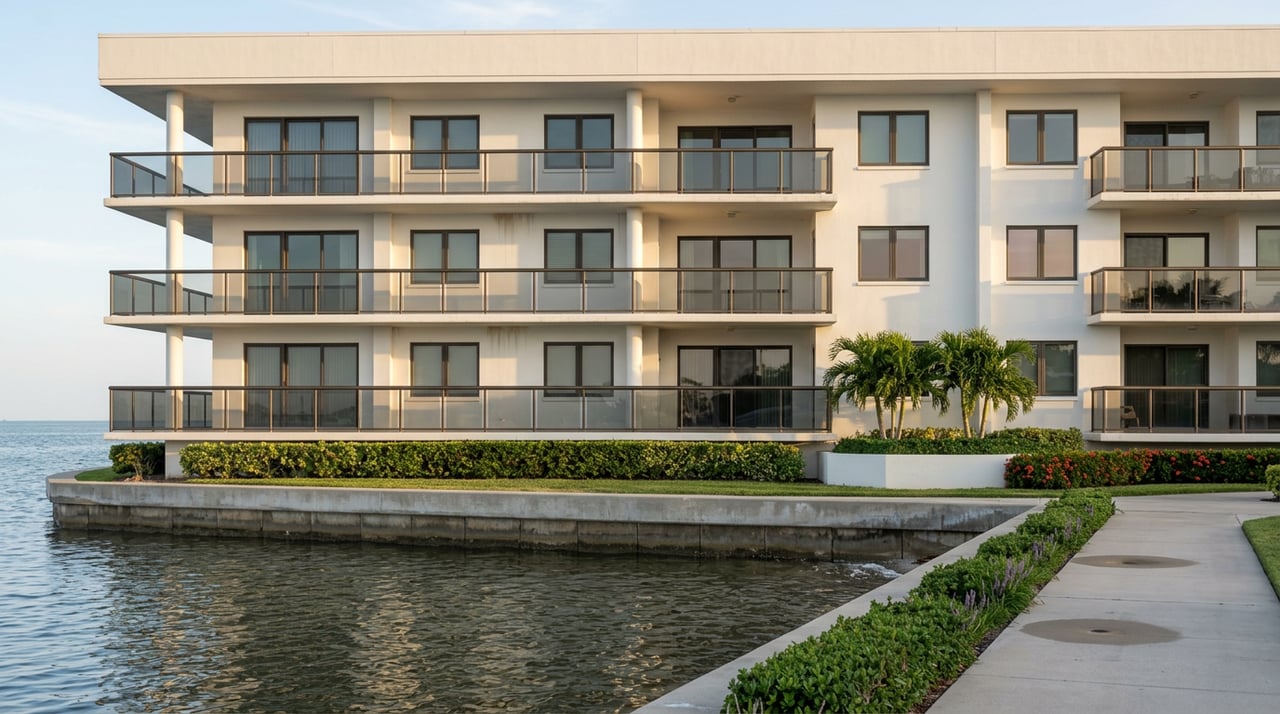
Two condos, same building, same floor, same view of Estero Bay. One owner pays $650 a month in dues. The other pays $1,150. On paper, the cheaper unit looks like the better deal. Ask for the reserve study on both and the story flips: the $650 unit sits in an association that spent a decade voting to waive structural reserves, and the $1,150 unit sits in one that didn't. As of this year, that difference is no longer something a board can vote its way around, and it's no longer something a buyer can afford to skip past on the way to the home inspection.
The Vote That Used to Make This Invisible
For most of the last twenty years, a Florida condo association facing a big number in its reserve study had an easy out. Unit owners could vote, by simple majority, to waive or underfund the reserves earmarked for the roof, the structure, the plumbing, whatever the study flagged as expensive and far off. Dues stayed low. Nobody complained. The bill just moved down the road.
That road ran out after Champlain Towers South collapsed in Surfside on June 24, 2021, killing 98 people. The investigation that followed traced the failure back to exactly this pattern: deferred maintenance and reserves that had been voted away year after year. The Legislature responded with Senate Bill 4-D in May 2022, then refined it with SB 154 in 2023, HB 1021 in 2024, and HB 913, which took effect July 1, 2025. The combined effect is what actually changes a Bonita Springs buyer's math in 2026: for budgets adopted on or after December 31, 2024, an association can no longer vote to waive or reduce reserves for the structural components a Structural Integrity Reserve Study identifies. Full funding was required to begin by January 1, 2026. The safety valve is gone.
What's Actually in the Study
A Structural Integrity Reserve Study, or SIRS, is required for any residential condo or co-op building three or more habitable stories tall, and it has to be redone at least every ten years. It covers eight specific components, and each one is a line item that either has money behind it or doesn't.
| Component | Why it matters to a buyer |
|---|---|
| Roof | Full replacement is a per-unit cost, not a per-owner discount |
| Load-bearing structure | Concrete spalling and rebar corrosion are common on Gulf-facing buildings |
| Fireproofing and fire protection | Code-driven, rarely optional, expensive to retrofit |
| Plumbing | Cast-iron risers in older buildings often need full replacement, not patching |
| Electrical systems | Panel and wiring upgrades tied to occupancy load |
| Waterproofing and exterior painting | Recurring cycle, but the interval shortens near salt air |
| Windows and exterior doors | Wind-rating code changes since Hurricane Andrew push older glazing toward mandatory replacement |
| Any other item over $25,675 (2026 threshold) | Catch-all for anything else tied to the seven named categories above |
That last number isn't arbitrary. The statutory base threshold started at $10,000, was raised to $25,000 under HB 913, and is now adjusted annually for inflation. The 2026 figure is $25,675. If a study flags an item above that line, and it's connected to one of the seven named structural categories, the association has to fund it. No vote required, and no vote allowed to stop it.
Bonita Springs Buildings Are Not All on the Same Clock
The default trigger for a milestone inspection is 30 years from the certificate of occupancy. But local building departments in coastal jurisdictions can move that up to 25 years, and Lee and Collier County buildings frequently fall under that earlier rule because of proximity to the coast. Two buildings of identical age, one three miles inland and one on the water, can owe their first inspection in different years for that reason alone.
This is why the age of a Bonita Springs condo building tells you less than you'd think. An older Gulf-front mid-rise at Barefoot Beach is the kind of building most likely to already be deep into its milestone and SIRS cycle, carrying the salt-air exposure that accelerates concrete deterioration and pushes reserve numbers higher than an inland building of the same vintage. Compare that to Infinity at The Colony, the 22-story tower that opened this year within The Colony at Pelican Landing, built by The Ronto Group in partnership with Wheelock Capital. A brand-new building still has to have a SIRS on file, since the requirement is triggered by height, not age, but it starts with a clean slate instead of a decade of waived reserves to catch up on.
The takeaway isn't that older buildings are bad investments. It's that a building's age and a building's financial exposure are two different questions, and only one of them shows up in the listing photos.
The Documents That Matter More Than the Walkthrough
A buyer touring a Bonita Springs condo can check the countertops and the lanai in twenty minutes. The documents that actually determine what this purchase costs over the next five years take longer to read, and most buyers never ask for all of them before writing an offer.
- The SIRS itself. Not a summary. The full report, showing which of the eight components are underfunded and by how much.
- The milestone inspection status. Florida's standard Condominium Rider now includes a checkbox for whether the building is required to have completed a milestone inspection under section 553.899 and whether it actually has. A seller who checks the box for "required but not completed" is handing you a known unknown.
- The estoppel certificate. This is where a pending or already-approved special assessment has to show up, along with the assessment paid-through date. If the board has approved an assessment but hasn't billed it yet, this is the document that reveals it before you close.
- Two years of board meeting minutes. This is the one buyers skip most often, and it's the one that tells you whether the association has been complying with the new funding rules or quietly falling behind. Under HB 1021, associations with 25 or more units are now required to post governing documents, budgets, and reserve studies to a website or app, so this information is more accessible than it used to be, but accessible doesn't mean anyone reads it.
When the Assessment Is Already on the Table
If a Phase 1 milestone inspection finds no substantial deterioration, that's the end of it until the next ten-year cycle. If it finds something, Phase 2 follows, and that's where destructive testing, core samples, and a real repair number come from. A Phase 2 finding is not automatically a reason to walk away from a contract. It's a reason to get specific about what the repair actually costs and who pays for it.
This is where a buyer's leverage lives. If the SIRS or a recent milestone report has already identified a funding shortfall, that shortfall is going to become a special assessment eventually, on someone's watch. The negotiation isn't about whether the building has a problem. It's about whether the seller absorbs the cost of fixing it or the buyer does. Asking a seller to fund an approved assessment in full at closing is a standard, reasonable ask once the number is on paper, and reading that number correctly is where a contractor's eye earns its keep. A reserve study is an engineering document dressed up as a financial one, and the difference between a routine roof reserve and a structural finding that's about to get expensive is not always obvious from the summary page alone.
A Few Questions Worth Asking Directly
Does this apply to a two-story or three-unit building? No. The SIRS and milestone inspection requirements apply specifically to condominium and cooperative buildings with three or more habitable stories. A low-rise garden condo or a duplex falls outside this framework entirely, though its association can still choose to fund reserves voluntarily.
If a building passed its Phase 1 inspection, does that mean no assessment is coming? Not necessarily. Phase 1 answers a safety question: is the building structurally sound today. The SIRS answers a financial question: does the association have enough saved to maintain that safety over the next ten to twenty years. A building can pass its inspection cleanly and still be sitting on an underfunded roof reserve that turns into a special assessment in three years.
Is a brand-new building like Infinity at The Colony exempt from all of this? No. The SIRS requirement is triggered by height, not age, so a condominium finished this year still needs a Structural Integrity Reserve Study on file. What it doesn't have is a backlog of deferred maintenance to fund, which is the real difference buyers should be pricing in.
If you're weighing a Bonita Springs condo purchase and want someone who can read a SIRS or a milestone report the way a licensed contractor reads it, not just the way a closing coordinator reads it, Jonathan Gunger has spent decades on the construction and permitting side of Southwest Florida's waterfront properties before moving into real estate. Reach out before you write the offer, not after the estoppel certificate arrives.