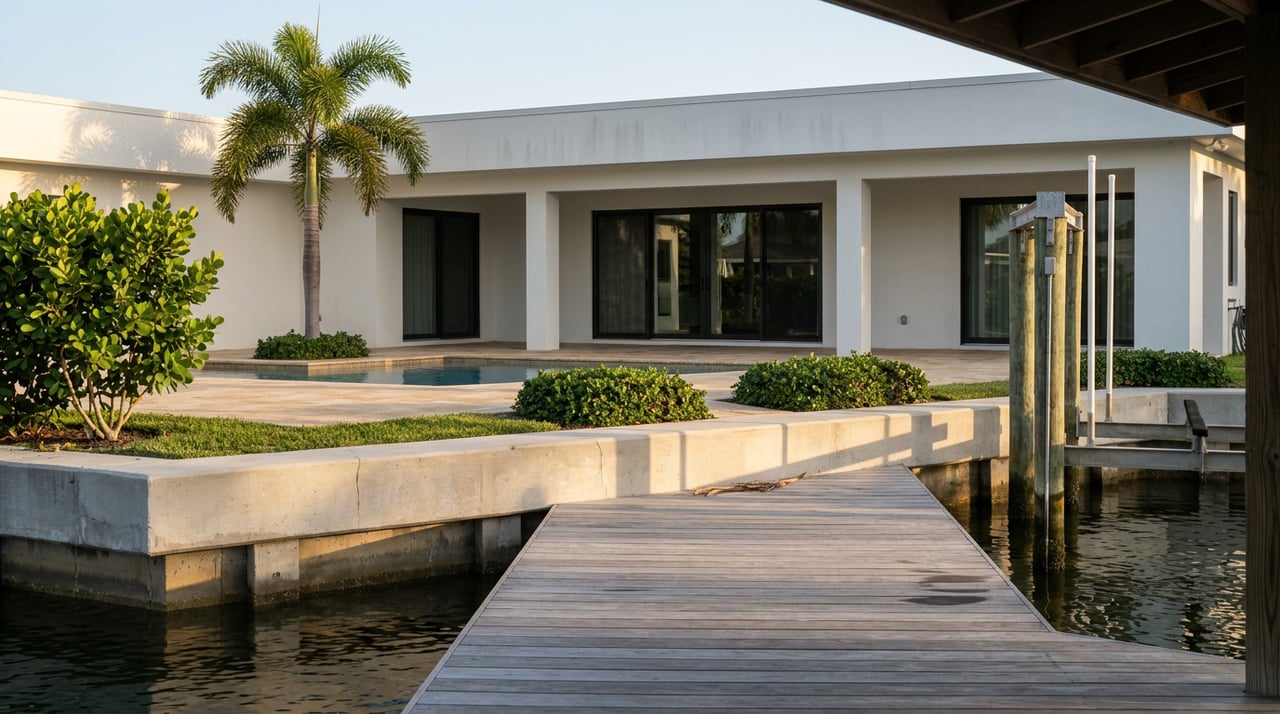
The kitchen never kills a Naples waterfront deal. Buyers walk through a dated kitchen, do the math on a remodel, and keep going. What actually stops a deal cold shows up eighteen inches below the seawall cap, where nobody looks until a professional engineer says look here.
Florida's standard AS-IS contract gives buyers a defined window, typically 15 days, to inspect a property and cancel for any reason with earnest money returned. What that contract does not give either side is a built-in mechanism to negotiate repairs. The form that lets buyers request fixes and sellers counter with credits exists in Florida real estate. The AS-IS version removes it on purpose. Once a buyer finds a seawall problem inside that window, the parties are left to work it out informally, under a deadline, or the buyer exercises the only formal right the contract actually gives them: walking away with a full refund. For a Naples canal-front seller, that is the entire risk. Not the repair cost. The binary choice a discovery forces onto a clock that was already running before the seller thought to look.
Why the Repair Clause Disappeared From Your Contract
Most Naples waterfront resales use the Florida Realtors and Florida Bar AS-IS Residential Contract, which strips out the traditional repair-negotiation paragraph entirely. Under that form, the property is sold in its current condition, and the seller has no contractual obligation to fix anything or issue a credit. What survives is the buyer's inspection period and the right to cancel for any reason at all, no explanation required, full deposit back.
Florida law layers one more obligation onto that framework regardless of what the contract says. Under the state's Johnson v. Davis doctrine, a seller who knows about a material defect that a buyer would not discover through ordinary observation has to disclose it. A cracked seawall cap or a soft spot in the yard behind the wall is exactly the kind of thing that doctrine was written for: it sits below the waterline, it is not visible during a walk-through, and it materially affects value. So the seller's choice is not whether to reveal a known problem. It is whether to find out before the buyer's inspector does, on the seller's own timeline instead of the buyer's countdown clock.
The AS-IS contract does not remove the negotiation. It just moves it from a scheduled paragraph to an unscheduled phone call, with fifteen days on the clock and the buyer holding the only formal exit.
What a Seawall Actually Costs, Compared to What It Threatens
The numbers only make sense side by side. A professional engineer's seawall inspection, often paired with a diver for the underwater portion, typically runs $300 to $800 and turns around a written report in 24 to 48 hours. A general visual inspection without the engineering component runs $200 to $600. Both are small enough that most sellers treat them as optional.
Full seawall replacement runs $800 to $1,000 per linear foot in Southwest Florida, which puts a 100-foot canal lot, a common enough frontage on a Naples waterfront parcel, at roughly $100,000 for the wall alone, before a dock or boat lift factors in. Seawalls in this region carry a useful life of roughly 25 to 50 years depending on installation quality and exposure, which means a wall built during Naples' first wave of canal development in the late 1940s and 1950s is now well past its midpoint on that scale even if the cap still looks clean.
| Line item | Typical cost | When it applies |
|---|---|---|
| PE inspection with diver review | $300 to $800 | Before listing, on the seller's schedule |
| Visual-only inspection | $200 to $600 | Quick screen, no underwater component |
| Full seawall replacement | $800 to $1,000 per linear foot | Once tie-backs or panels have failed |
| Buyer-requested credit at discovery | Reported as high as $50,000 | Negotiated informally inside the 15-day window |
A seller who skips the $300 to $800 inspection is not saving money. They are betting that the buyer's inspector, working on the buyer's timeline with the buyer's leverage, finds nothing worse than what a pre-listing report would have priced calmly weeks earlier.
The Naples Neighborhoods Where This Matters Most
The risk is not evenly spread across the city. Local marine contractors who work these canals every week point to specific pockets. Old Naples and Royal Harbor docks see some of the heaviest wear in the market because of constant tidal flow and warm, brackish water that shortens the working life of pilings and hardware. A piling that might last two decades in a freshwater setting can fail in as little as eight years in these conditions.
Aqualane Shores and Port Royal present a different problem. Their seawalls often hide damage behind clean caps and fresh paint, which is precisely why a visual walk from the yard tells a buyer almost nothing. Both neighborhoods carry some of the highest per-foot land values in Naples, and both sit on deep, no-bridge canals that were dredged and filled starting in the late 1940s. A wall that looks freshly maintained from above the waterline can still be losing soil behind it through weep holes and small gaps that only a diver or a low-tide walk would catch.
This is the part sellers in these neighborhoods tend to underweight. The polish that makes a listing photograph well is the same polish that can mask the one structural question a buyer's engineer is going to ask first.
The FEMA Rule That Caps What You Can Fix Instead
Seawalls are not the only structural ceiling on a Naples waterfront renovation. FEMA's Substantial Improvement rule caps how much a homeowner can spend on repairs or upgrades before the entire structure has to meet current flood elevation standards, which in practice often means elevating the house. The threshold is 50 percent of the structure's market value, and the City of Naples calculates that baseline using the Collier County Property Appraiser's assessed value plus 20 percent, though a private appraisal can sometimes provide more room to work with.
That detail matters for sellers weighing whether to fix a seawall before listing or leave it as a documented, priced item for the buyer to inherit. A seawall repair itself is not typically what triggers the 50 percent threshold on its own, but sellers planning a broader pre-listing improvement plan need to know that the ceiling is measured against the structure's assessed value, not against whatever a contractor's estimate assumes the house is worth. Getting that number wrong before signing a renovation contract is its own way to blow up a timeline.
What Changes When You Inspect Before You List
A pre-listing seawall packet does not eliminate the underlying condition of the wall. It changes who controls the narrative around it.
- A written PE report, dated before the listing goes live, turns an unknown into a documented, priced condition
- Buyers see a number they can underwrite instead of a discovery they have to react to inside a 15-day window
- Sellers can choose to repair, price around the finding, or disclose and move forward, on their own schedule
- The City of Naples' marine permit for seawall work carries a base application fee around $100 plus roughly $60 per inspection, small relative to what a rushed repair costs once a closing date is on the line
- A documented inspection gives an agent something concrete to point to when a buyer's own engineer raises a concern during their window
None of this requires guessing what a buyer will find. It requires finding it first.
A Few Questions Worth Asking Directly
Does the AS-IS contract mean I don't have to disclose a seawall problem I already know about? No. Florida's Johnson v. Davis doctrine requires sellers to disclose known material defects that are not readily observable, and a below-waterline seawall issue fits that description directly. The AS-IS label affects who has to pay for repairs. It does not affect the duty to disclose what you already know.
Does a seawall inspection actually fit inside the 15-day window if I wait until under contract? The inspection itself can turn around in 24 to 48 hours once scheduled. Scheduling is the variable. Marine contractors in Naples get busier ahead of hurricane season, and a seller who waits until a buyer's clock starts is competing with every other transaction trying to book the same specialists in the same window.
Naples waterfront pricing has never been just about square footage or finish level. The wall between the yard and the canal is doing structural work the rest of the house depends on, and the deals that survive their inspection period are usually the ones where somebody looked at that wall before the buyer's engineer had to.
If you are weighing whether to list a canal-front property in Old Naples, Aqualane Shores, Port Royal, or Royal Harbor, Jonathan Gunger brings a licensed contractor's read on seawalls, permitting, and renovation scope to the conversation before a listing goes live, not after a buyer's inspector raises the question. Get Your Instant Home Valuation to start that conversation with real numbers in hand.