When a tropical system targets Fort Myers Beach, minutes matter. Estero Bay’s shallow waters, fast-moving surge, and flying debris can turn a routine tie-up into a costly loss. If you own a boat and lift on the bay, you need a clear, local plan you can execute fast. In this guide, you’ll get a simple decision framework, a step-by-step timeline, and a practical checklist tailored to Estero Bay conditions. Let’s dive in.
Why Estero Bay needs its own plan
Estero Bay is shallow with winding channels, which can amplify wave action and surge during storms. Strong currents, floating debris, and boat traffic add impact risks around private docks and lifts. Common failures here include piling pull-out, cross-member shear, floating dock uplift, and lift strap failure.
Hurricane season runs June 1 through November 30, with peak risk from August to October. Your best predictors of inundation are storm surge maps and official advisories. Follow updates from the National Hurricane Center, Lee County Emergency Management, the Town of Fort Myers Beach, the U.S. Coast Guard, and Florida Fish and Wildlife Commission.
Decide early: haul, lift, or water
A clear decision ahead of time prevents last-minute mistakes.
Best option: haul inland
If you can trailer the boat inland and secure it on high ground, do it. This removes the vessel from surge and debris. Strap the hull to independent ground anchors or solid footings if allowed, and block the keel with proper stands.
If you must leave it on the lift
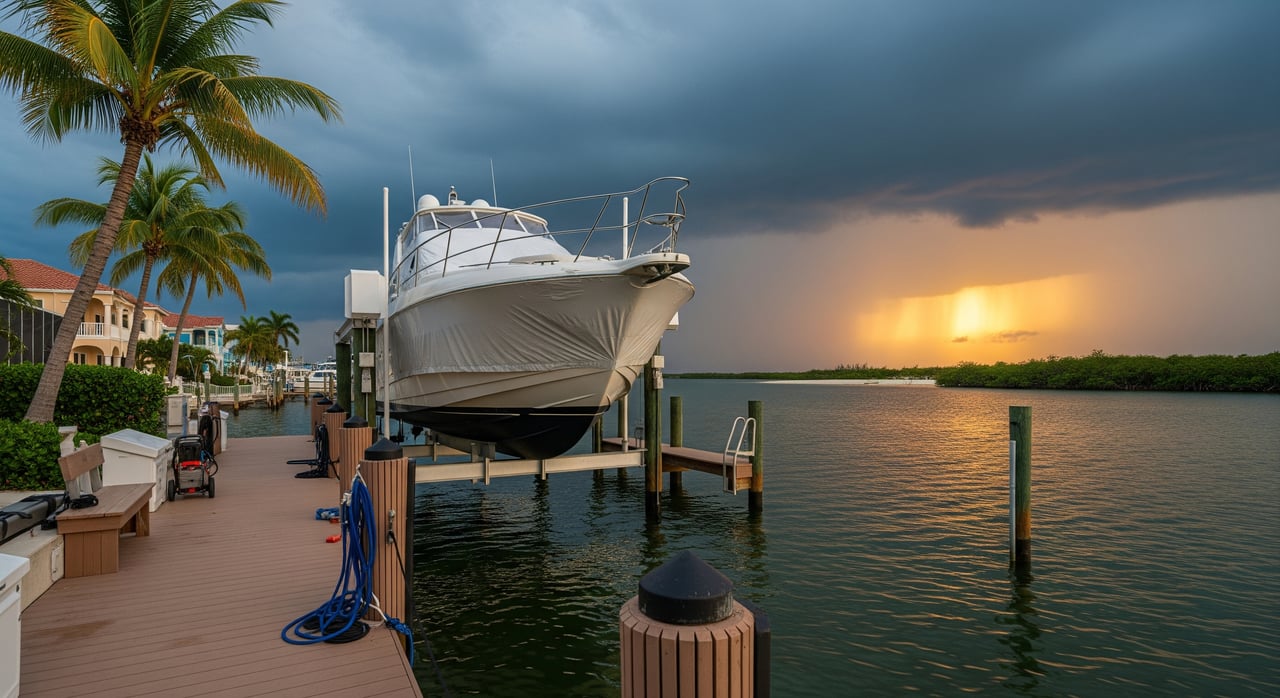
Follow your lift manufacturer’s hurricane procedure and consult the installer. Some models are designed to keep the boat on the lift if properly braced; others should be lowered. Inspect cross-bracing, collars, and fasteners, add supplemental straps from hull to piles, remove any canopy fabric, and disconnect power at the breaker.
If you must leave it in the water
Choose the most sheltered spot available or a marina with a proven storm plan. Use redundancy with multiple nylon lines, chafe protection, and lines to separate pilings to spread loads. If anchoring away from structures, set multiple anchors in opposing directions, understanding that hurricane-force winds and surge can overwhelm anchors.
7-day storm prep timeline
A simple, staged approach keeps you ahead of the rush.
7+ days out
- Confirm your plan: haul inland, leave on lift with bracing, or move to protected mooring/marina.
- Inspect lift, cradle, slings, and hardware; schedule service if corroded or loose.
- Gather heavy lines, chafe gear, webbing straps, shackles, and spare fuses.
- Update insurance details, photos, and serial numbers; store in the cloud.
72–48 hours out
- Follow the lift manufacturer plan: reinforce and secure, or lower per instructions.
- Remove sails, biminis, canvas, and loose items; store electronics indoors.
- Install multiple tie-downs: bow, stern, and at least two spring lines; add bridles and extra lines to separate pilings.
- Top off and stabilize fuel; test bilge pumps and confirm battery backups.
- Secure or remove outboards; lock steering and tilt up if left installed.
- Disconnect shore power at the breaker while it is still safe to access.
24 hours out
- Recheck every line, knot, shackle, and chafe point.
- Clear the dock of anything that can float or fly.
- Evacuate if ordered. Do not stay for last-minute adjustments.
After the storm (when permitted)
- Document damage with photos and video before moving anything.
- Contact your insurer and, if needed, local salvage professionals.
- Report navigational hazards to authorities and follow local permitting rules before repairs.
Tie-downs and lines that hold
Strong tie-downs reduce shock loads and chafe.
- Use redundancy. Bow, stern, and at least two spring lines are a baseline. Add auxiliary lines where you can.
- Choose the right material. Nylon lines offer shock absorption; low-stretch polyester can help hold consistent tension.
- Protect against chafe. Use chafe guards, hose, thimbles, or sleeves wherever lines touch hardware or pilings.
- Spread the load. Distribute lines to separate pilings or cleats so no single point takes all the force.
- Don’t over-tighten. Lines should be snug but allow some movement with surge to avoid hardware failure.
Lift, cradle, and dock checklist
Always prioritize model-specific guidance from your lift manufacturer and the installing company.
Pile-mounted fixed lifts
- Inspect cross-bracing, collars, and fasteners; tighten and replace corroded parts as needed.
- Add supplemental straps from hull to piles or strong cleats for redundancy. Do not rely only on slings.
- Block cradles and check bunks or pads; replace deteriorated components.
- Remove canopy fabric or decking that can catch wind.
- Disconnect power at the breaker. Know the manual override if the lift loses power.
Floating or sling systems
- Consider removing the boat if surge may exceed the lift’s freeboard.
- If left in place, run additional lines to multiple pilings and secure or remove components that can wash away.
Electrical and shore power safety
- Disconnect shore power before high water arrives, following marina or installer guidance.
- Never work on electrical systems during the storm or when docks are flooded.
- Consider ground-fault protection and high-water shutoffs to reduce risk in future events.
Protect engines, canvas, and bilge
Small steps here reduce damage and claims.
- Engines and outboards: Remove and store indoors when feasible. If left on, tilt up, secure with transom straps, and lock the steering.
- Canvas and sails: Remove biminis, enclosures, and sail covers to cut windage.
- Bilge and batteries: Test automatic pumps, confirm battery charge, and verify backups are ready before disconnecting shore power.
Document and insure before and after
Good records speed up claim approvals and repairs.
- Photos and video: Capture the vessel, lift, dock connections, and serial numbers before you leave.
- Keep inventory: Save receipts for maintenance, lift installations, and upgrades. Store documents in the cloud and share with your insurer.
- Coverage check: Understand that wind and flood are often separate coverages. Ask how your policy treats docks, lifts, and fixed structures.
After the storm: safe recovery
Your safety comes first.
- Wait for local authorities to clear re-entry. Avoid docks during high water or unstable conditions.
- Record conditions with photos and location notes. Report debris or hazards in Estero Bay to marine authorities.
- Obtain required permits before repairing pilings, docks, or navigational structures.
Quick homeowner checklist
Use this to act fast when a storm is approaching.
- Pre-season
- Inspect lift and hardware; service if corroded.
- Update insurance info and cloud-stored photos.
- Build your contact list: installer, marina, marine contractor, salvage, insurer, and county emergency management.
- Stock lines, chafe gear, straps, shackles, and anchors.
- 5–7 days out
- Decide your plan: haul inland, secure on lift, or move to protected marina/mooring.
- Remove electronics, canvas, sails, and personal items.
- 72–48 hours out
- Execute manufacturer’s lift plan; reinforce or lower as directed.
- Disconnect shore power; secure panel while safe.
- Install bow, stern, springs, and auxiliary lines with chafe protection.
- Secure or remove outboards; top off fuel; test bilge pumps and backups.
- 24 hours out
- Final line and hardware check; clear the dock.
- Evacuate if ordered.
- After the storm
- Photograph everything; contact insurer and professionals.
- Follow local guidance for debris and environmental safety.
Local resources to monitor
- National Hurricane Center and NOAA for storm and surge guidance.
- Lee County Emergency Management for evacuation zones and local advisories.
- Town of Fort Myers Beach for local updates and ordinances.
- U.S. Coast Guard and Florida Fish and Wildlife for boating advisories and reporting.
- BoatUS and Florida Sea Grant/UF IFAS for storm prep guidance specific to boats and docks.
- Your lift and dock manufacturer or installer for model-specific procedures.
Get help with coastal property decisions
If you own, buy, or sell on the water, the right plan protects your boat today and your property value tomorrow. With decades of waterfront development experience, Jonathan brings contractor-level insight on docks, lifts, seawalls, and permitting to your real estate decisions. Ready to talk resiliency, value, and next steps for your Fort Myers Beach or Naples-area property? Connect with Unknown Company to get started.
FAQs
Should I leave my boat on the lift or lower it into Estero Bay?
- There is no one-size-fits-all answer. Follow your lift manufacturer’s hurricane guidance and ask the installer. Hauling inland is safest. A well-rated, well-maintained lift with proper bracing can be an option, but older or corroded systems are high risk.
How many lines do I need for a storm tie-up on a private dock?
- Use redundancy: bow, stern, and at least two spring lines, plus extra lines to separate pilings. Protect every contact point with chafe gear, and size lines for your boat and conditions.
When should I disconnect shore power to my lift and dock?
- Disconnect before high water arrives and only while it is safe to access breakers. Include this step 24–48 hours before expected impact, following marina and installer guidance.
Will my homeowner’s policy cover damage to docks and lifts in Lee County?
- Sometimes. Coverage varies by policy and carrier. Wind and flood are often separate, and docks or lifts may require specific endorsements or marine policies. Confirm details with your insurer.
Who should I call locally for storm prep or recovery around Fort Myers Beach?
- Line up contacts in advance: your lift installer, a qualified marine contractor, your marina, a licensed salvage/towing firm, and Lee County Emergency Management for official updates.