Buying a waterfront home in Fort Myers is exciting, but the purchase price is only part of the financial picture. If you are comparing canal-front homes, riverfront properties, or condos near the water, the real question is often this: what will it cost to carry the property month after month and year after year? The good news is that the biggest cost drivers are predictable once you know where to look. Let’s break down the numbers and the line items that matter most.
Why carrying costs vary so much
Fort Myers waterfront homes can have very different ongoing costs even when two properties look similar online. The biggest variables are usually insurance, property taxes, utility setup, HOA or condo dues, and waterfront infrastructure like docks and seawalls.
According to public guidance from Lee County Property Appraiser exemption information, costs can also change based on whether the home is your primary residence, whether it qualifies for homestead protections, and whether it sits in a Special Flood Hazard Area such as A, AE, AH, AO, VE, or V.
Start with insurance first
For many waterfront owners, insurance is the most important carrying-cost category to estimate accurately. That includes both homeowners insurance and, in many cases, flood insurance.
A useful statewide benchmark comes from the NAIC’s 2025 consumer materials, which describe Florida as the most expensive state for homeowners insurance, with an average premium of $9,462 per year, or about $789 per month, for a typical homeowner. That is not a Fort Myers quote, but it gives you a realistic starting point for planning.
Flood insurance is separate
One of the most common misconceptions is that homeowners insurance covers flood damage. FEMA states that most homeowners insurance does not cover flood damage, so waterfront buyers should usually treat flood coverage as its own budget line.
A county-level NFIP-based estimate cited by LendingTree’s Florida flood insurance analysis puts Lee County at about $1,417 per year. The same source shows Florida benchmark ranges of about $610 annually in B/C/X zones, $1,067 in AE, $1,386 in A, and $2,412 in V. Those are reference points, not guarantees, but they help frame how much flood zone can affect your budget.
Elevation can change the math
Flood pricing is not only about the map zone. FloodSmart explains that pricing can also reflect factors like first-floor height, foundation type, flood frequency, distance to water, and other property details.
That means two waterfront homes on the same street may not carry the same flood premium. If a property has an elevation certificate and the home sits higher or includes features that improve protection, the premium may be lower than you expect.
Property taxes can differ by location
Property taxes are another major carrying cost, and they can vary more than buyers realize. A home inside Fort Myers city limits may have a meaningfully different bill than a similar property in unincorporated Lee County.
The clearest public example comes from the Lee County FY25-26 Budget Book. Its sample bill shows a $275,000 home with a $50,000 homestead exemption at $3,858 in Fort Myers versus $2,600 in unincorporated Lee County. That is a $1,258 difference on the same taxable value, and it does not include non-ad valorem assessments.
Homestead status matters
If the property will be your primary Florida residence, homestead benefits can make a real difference. According to Lee County Property Appraiser exemption rules, homestead can reduce taxable value by up to $50,000, and Save Our Homes can cap annual assessment growth at 3%.
Second homes and rentals do not qualify for those protections. If you are buying a seasonal property or investment home, your annual tax estimate may be higher than a primary resident’s estimate for the same address.
Utilities and assessments still count
Utilities may not be the largest line item, but they should not be treated as an afterthought. In Fort Myers, the bill structure depends on whether the home is city-served or county-served.
For city-served homes, the City of Fort Myers utility rate schedule shows charges based on water and sewer consumption, readiness-to-serve fees, and a 10% utility tax. The same schedule also notes tiered water rates, so irrigation or high water use can push costs up.
For county-served homes, Lee County Utilities lists recurring single-family fees of $4.33 administrative, $11.52 water base fee, and $21.44 sewer base fee, before usage.
Stormwater is a separate line item
If the home is within the City of Fort Myers, stormwater can show up as a non-ad valorem assessment. The city’s Stormwater User Fee page states that the charge is $2.16 per standard impervious unit per month, billed annually.
The city gives a simple example: a parcel with 2,000 square feet of impervious area equals 4 SIUs, or $8.64 per month before any approved credits. It is not usually the biggest expense, but it belongs in the total carrying-cost estimate.
Solid waste may apply in some areas
In nearby unincorporated Lee County service areas, annual residential solid-waste assessments range from $348.75 to $381.11 per single-family unit, based on the county’s adopted solid-waste rates. Depending on the property location, this may appear as another recurring cost to account for.
HOA and condo dues can change the budget fast
Waterfront buyers sometimes focus so much on taxes and insurance that they underestimate the impact of association fees. In reality, HOA and condo dues can range from minimal to substantial.
Public listing examples in the Fort Myers waterfront market show a wide spread, including no HOA, $95 per month, $333 per month, $250 per month plus a second $213 monthly fee, and $887 per month. These examples are not market averages, but they are useful reminders that dues should be verified separately for each property.
What association fees may cover
Association fees vary because the scope of coverage varies. A public condo listing example cited in the research shows fees may include management, legal and accounting, grounds maintenance, reserve funding, street lights, security, and trash.
That is why two similar-looking waterfront condos can have very different monthly obligations. Before you assume a fee is high or low, it helps to confirm what the association is actually paying for.
Docks and seawalls are often reserve items
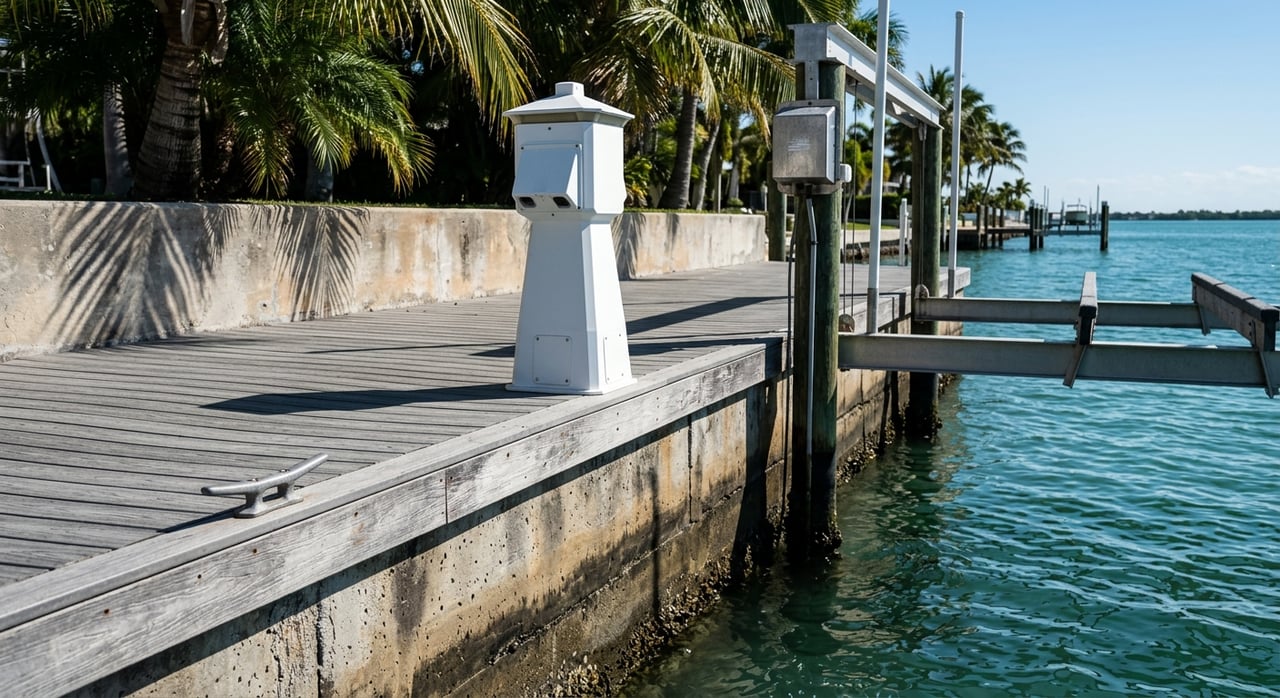
For single-family waterfront homes, the dock, lift, and seawall can be just as important as the house itself. These items do not always create a fixed monthly bill, but they can create major capital costs over time.
Lee County’s dock permitting guide shows that dock-related structures can include boatlifts, davits, boathouses, fishing piers, boardwalks, mooring pilings, seawalls, riprap, and dredging. The same guide lists permit-fee examples such as $0.25 per square foot for boat dock or boardwalk work with a $50 minimum, $75 for a boatlift or boathouse, and $0.25 per linear foot for seawalls or retaining walls with a $50 minimum.
Permit fees are only one part of the story. Recent City of Fort Myers permit final records cited in the research show examples including a 497-square-foot dock with boat lift at $53,936, another dock rebuild with lift and boathouse at $54,000, and a 124-foot seawall replacement at $31,000.
Think in terms of reserves
Because these costs are irregular, it usually makes more sense to treat them as reserve or capital-maintenance items instead of monthly expenses. If a home has aging shoreline infrastructure, your true carrying cost may include setting aside funds for future work even if no immediate repair is needed.
This is one area where technical review matters. On waterfront property, condition, permitting history, and ownership obligations can materially affect your long-term budget.
A simple Fort Myers carrying-cost checklist
If you want a more realistic estimate before you make an offer, verify these items for the specific property:
- Flood zone classification
- Whether an elevation certificate exists
- Current property tax bill
- Any non-ad valorem assessments
- Whether utilities are city-served or county-served
- Irrigation and water-use setup
- HOA or condo dues and what they cover
- Dock, lift, and seawall permits or maintenance obligations
The research report also points to Lee County’s elevation certificate search tools as one place to confirm whether a certificate may already be on file for a property.
A practical way to estimate monthly costs
A simple framework can help you compare properties more clearly. Start with these categories:
- Property taxes
- Homeowners insurance
- Flood insurance
- HOA or condo dues
- Utilities and stormwater
- Solid waste or other assessments
- Reserve for dock, lift, or seawall maintenance
From there, separate fixed recurring costs from irregular capital items. That helps you see whether a lower-priced home is actually cheaper to own, or whether deferred waterfront infrastructure may offset the lower purchase price.
Why this matters in Fort Myers
In Fort Myers, the most defensible public-data takeaway is simple: insurance and taxes usually lead the budget, followed by association costs and shoreline systems, while utilities and stormwater are smaller but still property-specific. The strongest swing factors are flood zone, elevation, city versus county location, and whether the home includes shared amenities or private dock and seawall obligations.
If you are evaluating waterfront property, these details are not minor. They are part of the real investment decision, and understanding them early can help you avoid surprises later.
If you want help reviewing a Fort Myers waterfront home with both market perspective and contractor-level insight, connect with Jonathan Gunger. His waterfront and construction background can help you look beyond the list price and evaluate the ownership picture with more clarity.
FAQs
What are the biggest carrying costs for Fort Myers waterfront homes?
- The biggest costs are usually homeowners insurance, flood insurance, property taxes, HOA or condo dues if applicable, and waterfront infrastructure reserves for items like docks and seawalls.
Does homeowners insurance for a Fort Myers waterfront home include flood coverage?
- No. FEMA states that most homeowners insurance policies do not cover flood damage, so flood insurance should usually be estimated as a separate cost.
How does flood zone affect carrying costs for Fort Myers waterfront property?
- Flood zone can have a major effect on flood insurance pricing, with benchmark costs in Florida varying by zone and other property-specific factors such as elevation and first-floor height.
Do Fort Myers property taxes differ inside and outside city limits?
- Yes. Lee County’s sample tax comparison shows that the same taxable value can produce a meaningfully higher bill in Fort Myers than in unincorporated Lee County.
Why do Fort Myers waterfront condo fees vary so much?
- Condo fees vary because they may cover very different items, including management, reserve funding, maintenance, trash, lighting, security, and other shared expenses.
Should dock and seawall costs be treated as monthly expenses for Fort Myers waterfront homes?
- Usually, it is more practical to treat dock, lift, and seawall costs as reserve or capital-maintenance items since they tend to be irregular but can be expensive when work is needed.